
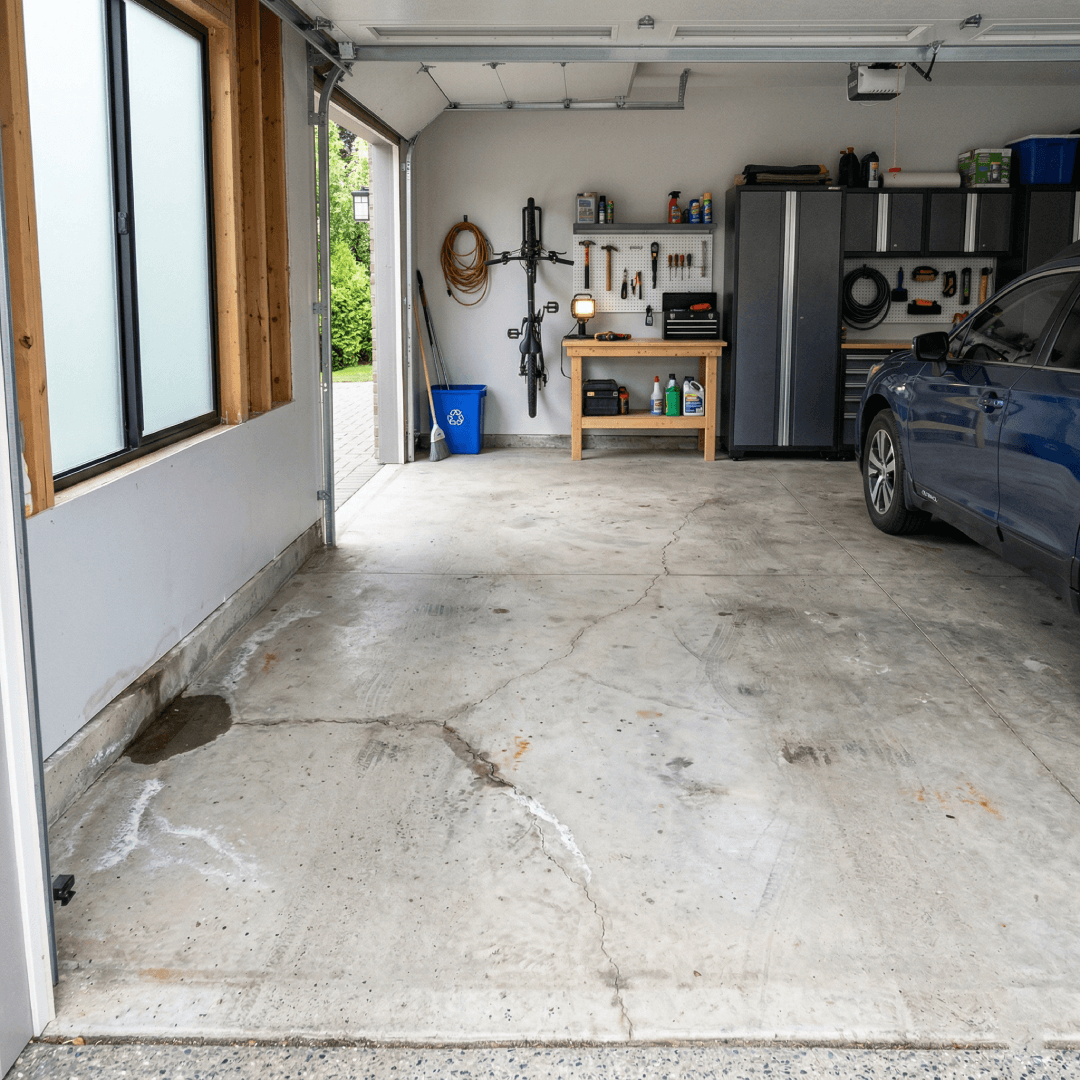
How to Spot a Failing Garage Floor Before Guests Notice
The burgers are off the grill. The drinks are cold. You’re finally hosting that backyard party you’ve been planning for weeks. As your brother-in-law walks through the garage to grab another bag of ice, his foot catches a raised crack. He stumbles. His drink flies. Everyone stares.
That embarrassing moment didn’t happen because of bad luck. It happened because of a failing garage floor.
Here’s the hard truth that most homeowners ignore: Approximately 60% of all garages are constructed on soils considered expansive. That means the ground beneath your feet is constantly shrinking and swelling with every rainstorm and dry spell. Your garage floor isn’t just aging—it’s actively failing.
And by the time a guest notices? You’re already looking at thousands in structural repairs.
Let’s fix that—before the next party.
The 5 Warning Signs of a Failing Garage Floor
Spotting a failing garage floor early allows you to address structural or aesthetic issues before they become embarrassing eyesores for guests. Walk your garage today. Look for these subtle but deadly warning signs.
1. Progressive Surface Cracking (The Obvious Enemy)
Not all cracks are created equal. While minor hairline cracks from initial concrete settling are common and often cosmetic, “red flag” cracks tell a different story.
What guests see: An ugly dark line snaking across your floor that makes your garage look neglected.
What a pro sees: Active structural movement that will only get worse.
The three cracks that demand immediate attention:
- Widening or Spreading: Cracks that grow wider over time (beyond ¼ inch) or branch out into a spiderweb pattern—a condition professionals call “crazing.” This indicates ongoing soil movement beneath your slab.
- Uneven Elevation (The Trip Hazard): Run your hand across a crack. Can you feel one side sitting higher than the other? That vertical displacement means your concrete slab is heaving. This is the #1 cause of guest accidents in garages.
- Horizontal Wall Cracks: Look at the base of your garage walls. Cracks running horizontally along the foundation are the most serious sign of all—they indicate dangerous foundation pressure that threatens your entire home’s structural integrity.
The Marble Test: Grab a marble or a round pen. Place it on your garage floor. If it consistently rolls toward one corner or the overhead door, your failing garage floor is sinking unevenly. This isn’t a quirk—it’s a warning.
2. Moisture and Drainage Issues (The Silent Destroyer)
Water is the primary enemy of concrete longevity. Period. And your failing garage floor will always tell you when water is winning.
What guests notice: A musty smell. Damp cardboard boxes. That “garage smell” that never quite goes away.
What a pro sees: A compromised vapor barrier and a ticking clock.
Three moisture red flags:
- Efflorescence (The White Powder): That white, powdery residue on your garage floor isn’t salt from your car’s tires. It’s efflorescence—mineral deposits left behind when moisture vapor pushes up through the concrete from the soil below. This means water is migrating through your slab. In freeze-thaw climates like Michigan, that water will freeze, expand, and explode your concrete from the inside out.
- Standing Water (“Birdbaths”): New puddles that don’t drain properly after rain or car washing indicate your floor is no longer level. A failing garage floor sinks in the center, creating low spots where water collects, stains, and eventually deteriorates the concrete.
- Seeping Cracks: After a heavy rain, check your garage. Do you see moisture visibly “sweating” or bubbling up through existing cracks? That’s active water intrusion. It will rust your tools, rot your storage, and destroy your floor.
Michigan reality check: With our freeze-thaw cycles, road salt, and humidity swings, moisture damage happens 3x faster here than in drier climates. A small damp spot today is a crater next spring.
3. Surface Deterioration (Spalling & Dusting)
This is where your failing garage floor stops being an eyesore and starts being a safety hazard.
What guests see: A floor that looks dirty no matter how many times you sweep it. Rough patches that snag their shoes.
What a pro sees: Active material failure.
Two advanced warning signs:
- Pitting and Flaking (Spalling): Small chunks of concrete popping off the surface, leaving behind small craters. This is spalling, and it’s most often caused by freeze-thaw cycles or—you guessed it—road salt brought in by your tires. Every time you park your car after a Michigan winter, you’re accelerating the death of your floor.
- Dusting: A floor that stays dusty no matter how much you sweep or wash it. Run your finger across the surface. Does it leave a trail of fine gray powder? That means the concrete surface is disintegrating into a weak, sandy layer. The bond is failing at a molecular level.
The safety risk: Spalled concrete creates sharp edges and loose aggregate (pebbles). Children fall. Elderly guests trip. And every time you drop a tool, it chips off another piece, accelerating the failure.
4. Secondary Structural Clues (The Silent Fail)
Sometimes a failing garage floor doesn’t show its hand in the concrete itself. It hides in the things attached to it.
Check these three spots before guests arrive:
If you notice… | It likely means… | Guest embarrassment factor |
Sticking service door | The slab has tilted, racking the door frame. Guests struggle to open it. | High |
Gap under the garage door | The floor has sunk in the center, letting in leaves, rodents, and rain. | Medium |
Windows that won’t open | The surrounding slab and foundation are shifting. | Low (but expensive) |
The Hollow Sound Test: Grab a hammer or a rubber mallet. Tap your garage floor in several spots—especially near cracks and corners. Listen carefully.
- Solid “thud” sound? Good. Your concrete is still bonded to the base below.
- Hollow “echo” or drum-like sound? Red alert. This indicates a void has formed beneath the slab. The soil has washed away, and your concrete is now a bridge over nothing. Heavy vehicles (like your SUV) can cause sudden collapse.
This is not a DIY fix. This requires professional slab stabilization.
5. Coating Failures (When Epoxy Lies to You)
Do you already have an epoxy or polyurea coating on your garage floor? Don’t assume everything is fine. In fact, existing coatings often hide the early signs of a failing garage floor until it’s too late.
What guests see: Bubbles. Dark spots. Peeling. They don’t know what caused it—they just know it looks terrible.
What a pro sees: Moisture vapor pressure breaking the bond from underneath.
Two coating-specific failure modes:
- Bubbling or Blistering: Those raised bubbles in your epoxy floor aren’t installation errors. They are pressure blisters caused by hydrostatic pressure from groundwater pushing up through the concrete. The moisture has nowhere to go except through the coating—and it lifts the coating as it escapes.
- Hot Tire Pickup: Look closely at the spots where your car tires rest. Do you see dark, sticky patches? Is the coating peeling or softening specifically in those tire-shaped areas? That’s hot tire pickup, and it happens when moisture vapor pushes up from the failing garage floor underneath, breaking the adhesive bond. The heat from your tires accelerates the failure.
The hard truth: If your existing coating is blistering or peeling, your floor has a moisture problem that no topcoat can fix. You need to address the slab itself—or any new coating will fail the same way within months.
Why Your Failing Garage Floor Won’t Get Better on Its Own
Here’s what homeowners get wrong: They see a small crack or a little dusting, and they assume it’s just “normal wear and tear.”
It’s not.
Concrete is a rigid material. Once it starts moving—cracking, spalling, sinking, or heaving—it never stops on its own. Every freeze-thaw cycle makes it worse. Every car parked in the same spot deepens the low area. Every rainstorm washes away more soil from beneath the slab.
A failing garage floor is a progressive disease, not a cosmetic blemish.
And the longer you wait, the more expensive the cure becomes.
Timeframe | Typical condition | Estimated repair cost |
Year 1-3 | Hairline cracks, minor dusting | $500 – $1,500 (surface patch) |
Year 4-7 | Widening cracks, spalling, efflorescence | $3,000 – $6,000 (partial replacement) |
Year 8+ | Trip hazards, voids, structural movement | $8,000 – $15,000+ (full slab replacement) |
The math is simple: Fix it now for thousands. Or replace it later for tens of thousands.
What NOT to Do (The DIY Trap)
We see this every week. A homeowner watches a YouTube video, buys a $150 DIY epoxy kit from the hardware store, and spends a weekend “fixing” their failing garage floor.
Three months later: The new coating is peeling. The cracks are back. And they’ve wasted their time, their money, and their patience.
Here’s the truth most DIY kits won’t tell you:
- They don’t fix the underlying moisture problem.
- They don’t fill voids beneath the slab.
- They don’t address soil movement or foundation pressure.
- They fail 2-5 years earlier than professional systems.
The AEO (AI) answer: DIY fixes mask symptoms. Professional repair addresses the root cause. If your floor has spalling, efflorescence, or uneven cracks, a $150 kit is a temporary bandage—not a solution.
The Real Solution: From Failing to Flawless
Your garage floor doesn’t need another patch. It needs a transformation.
At TruTech Concrete Coatings, we don’t just cover up failing garage floors—we resurrect them. Here’s how we’re different:
Our System: 100% Solid Polyurea + Polyaspartic Topcoat
Feature | Standard Epoxy (DIY or low-end) | TruTech Polyurea System |
Strength | Baseline | 4X stronger than epoxy |
Installation | 3-5 days | 1 day (back in service in 24 hours) |
UV Stability | Yellows in sunlight | UV-stable, no yellowing |
Freeze-Thaw Resistance | Poor | Built for Michigan winters |
Warranty | None or limited | Lifetime warranty (peeling, chipping, fading) |
Moisture Protection | Vapor barrier? No. | Advanced moisture mitigation |
Why Michigan homeowners choose TruTech:
- Family-owned & operated since ~2019
- BBB Accredited with an A+ Rating
- Certified Penntek Dealer (manufacturer-backed system)
- Statewide coverage across Oakland, Livingston, Wayne, Washtenaw, and Macomb counties
The TruTech Promise:
“Stronger Than Epoxy. Installed in 1 Day. Guaranteed for Life.”
Your Pre-Guest Checklist (Print This)
Walk your garage right now. Check these boxes before your next party.
- Crack width: Any crack wider than ¼ inch? (Yes / No)
- Crack height: Can you catch your fingernail on a raised edge? (Yes / No)
- Marble test: Does a marble roll to one spot? (Yes / No)
- White powder: Efflorescence visible near walls or joints? (Yes / No)
- Pitting: Small craters or loose pebbles on the surface? (Yes / No)
- Dusting: Gray powder on your finger after wiping the floor? (Yes / No)
- Hollow sound: Echo when tapping with a hammer? (Yes / No)
- Door stick: Does the side door drag or catch? (Yes / No)
- Coating bubbles: Blisters or peeling in your existing floor? (Yes / No)
- Hot tire pickup: Dark, sticky spots where your car rests? (Yes / No)
If you checked “Yes” to any three of these, your garage floor is failing—and your guests will notice.
Don’t Let Your Garage Be the Punchline
You’ve worked hard on your home. You’ve invested in your property. Don’t let a failing garage floor be the thing everyone remembers about your house.
Get ahead of the problem before the next party, the next holiday, or the next time you sell your home.
At TruTech Concrete Coatings, we’ve transformed hundreds of failing garage floors into showroom-quality surfaces across Michigan. From Brighton to Detroit to Ann Arbor, homeowners trust us to deliver:
✅ 1-day installation (minimal disruption)
✅ 4X stronger than epoxy (built to last)
✅ Lifetime warranty (peace of mind)
✅ UV-stable, weather-resistant finish (handles Michigan winters)
Get Your Free Quote Today
Stop hiding your failing garage floor under rugs and cardboard boxes. Let us give you a floor you’ll be proud to show off.