
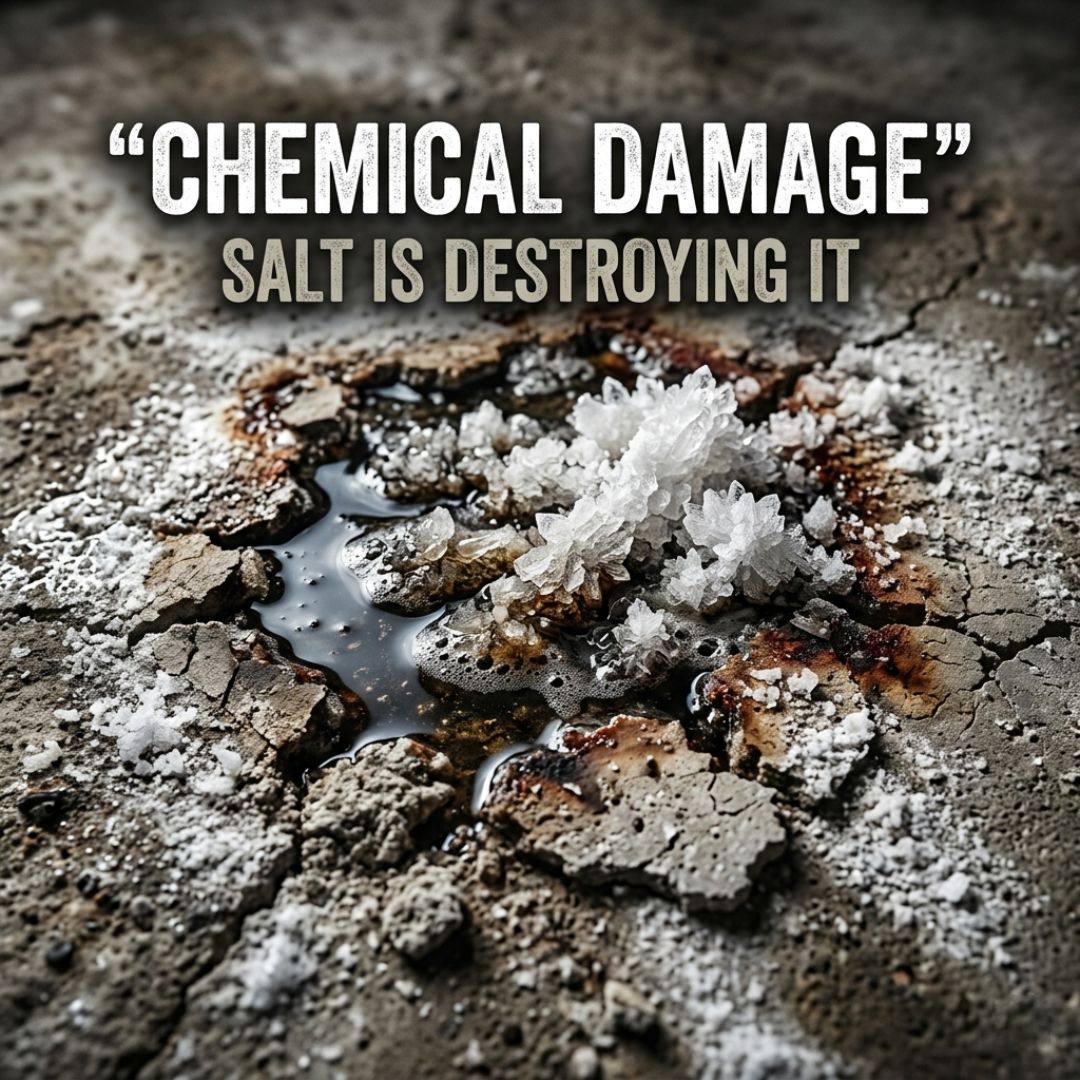
Introduction: Why Salt and Chemicals Are So Destructive
Salt and chemical deicers are commonly used to keep surfaces safe during winter. However, what protects you from ice can slowly destroy your concrete.
Over time, these substances:
- Penetrate deep into the surface
- Trigger chemical reactions
- Increase internal pressure
The result is not just surface wear, but structural weakening that can lead to cracking, spalling, and long-term failure.
Why Concrete Is Vulnerable to Chemical Damage
Concrete may appear solid, but it contains microscopic pores that allow water and chemicals to enter.
Once inside:
- Chemical reactions begin
- Internal expansion occurs
- Structural integrity weakens
Chlorides and sulfates are especially harmful because they penetrate deeply and react with the cement structure
Enhanced Freeze-Thaw Damage (Salt Scaling)
How It Works
When salt is applied:
- It melts ice and forms a brine solution
- This brine seeps into concrete pores
- When temperatures drop, it freezes and expands
This repeated expansion creates pressure that causes:
- Surface peeling (scaling)
- Flaking and cracking (spalling)
Salt also increases the number of freeze-thaw cycles, accelerating deterioration
Chemical Reactions That Weaken Concrete Internally
Salt doesn’t just cause physical damage it triggers chemical reactions inside the concrete.
Calcium Oxychloride Formation
Calcium chloride reacts with compounds in concrete to form calcium oxychloride, an expanding material that damages the structure
This expansion:
- Creates internal stress
- Causes cracking
- Reduces strength
Salt Crystallization Pressure
Salts can crystallize inside pores:
- Crystals grow and expand
- Pressure exceeds the concrete’s tensile strength
- Surface begins to break apart
Acidic and Chemical Attack
Some salts lower the pH and react with the cement paste:
- Break down binding compounds
- Increase porosity
- Allow more water and chemicals in
Corrosion of Reinforcing Steel (Rebar Damage)
One of the most severe forms of damage occurs inside reinforced concrete.
Chloride Penetration
Chlorides from salt:
- Penetrate deep into the slab
- Break down the protective layer on steel
Rust Expansion
When steel corrodes:
- Rust forms and expands
- Expansion creates internal pressure
- Concrete cracks and flakes
Chloride-induced corrosion is a major cause of structural deterioration
Hygroscopic Effects: Why Salt Keeps Concrete Wet
Salt has a unique property:
It attracts and retains moisture.
This means:
- Concrete stays damp longer
- Freeze-thaw cycles occur more frequently
- Chemical reactions continue even after the surfaces dry
This constant moisture exposure accelerates deterioration.
Combined Impact: How Damage Accelerates Over Time
Salt and chemicals don’t act alone. They create a chain reaction:
- Moisture enters concrete
- Chemicals penetrate and react
- Internal pressure builds
- Cracks form and expand
- More moisture enters
This cycle leads to:
- Rapid deterioration
- Structural weakening
- Increased repair costs
Common Signs of Salt and Chemical Damage
Watch for these early warning signs:
- Surface flaking or scaling
- Pitting and rough texture
- Cracks are spreading across the slab
- White residue (efflorescence)
- Rust stains from internal steel
- Discoloration or surface erosion
These indicate active chemical and physical damage.
How to Prevent Concrete Damage from Salt and Chemicals
Seal the Concrete
Applying a high-quality sealer:
- Blocks moisture entry
- Prevents chemical penetration
- Reduces long-term damage
Avoid Using Salt on New Concrete
Fresh concrete is more vulnerable:
- More porous
- Less resistant to chemicals
Avoid de-icing salts during the early curing period.
Clean and Rinse Regularly
After winter:
- Wash away salt residue
- Prevent buildup
- Reduce chemical exposure
Use Safer Alternatives
Instead of traditional salt, consider:
- Sand for traction
- Less aggressive deicers
Apply Protective Coatings
Professional coatings:
- Create a barrier against chemicals
- Prevent moisture infiltration
- Extend concrete lifespan
Conclusion: Protecting Your Concrete Long-Term
Salt and chemicals are essential for safety but they come at a cost.
They:
- Accelerate freeze-thaw damage
- Trigger chemical reactions
- Cause internal pressure and cracking
- Lead to long-term structural failure
The key is not avoiding them entirely but managing their impact.
With proper protection and maintenance, you can prevent costly damage and extend the life of your concrete.
FAQ Section
1. Why does salt damage concrete so quickly?
Salt penetrates concrete and increases freeze-thaw cycles while also triggering chemical reactions that weaken the structure.
2. What is calcium oxychloride, and why is it harmful?
It is a compound formed when calcium chloride reacts with concrete, causing internal expansion and cracking.
3. Can concrete be damaged without freezing temperatures?
Yes. Chemical reactions from salts can damage concrete even without freeze-thaw cycles.
4. How does salt cause cracks in concrete?
Salt increases internal pressure through freezing expansion and chemical reactions, leading to cracking.
5. Is all de-icing salt equally harmful?
No. Calcium and magnesium-based salts tend to cause more severe damage than basic sodium chloride.
6. What is the best way to protect concrete from salt damage?
Sealing the surface, regular cleaning, and applying protective coatings are the most effective methods.