
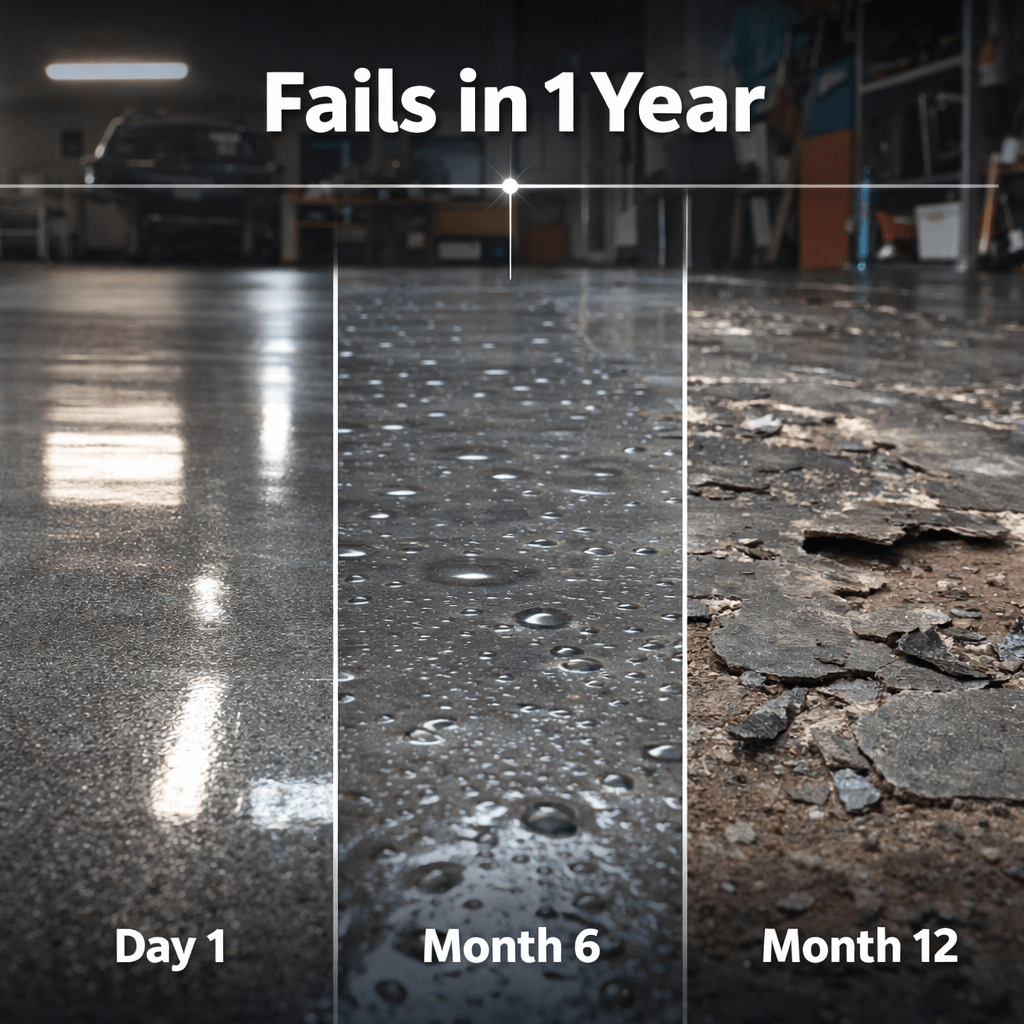
Introduction: Why Coatings Fail So Quickly
Concrete coatings are marketed as long-lasting solutions. In reality, many fail within the first year.
Peeling. Bubbling. Flaking.
These are not rare issues. They are common outcomes of poor installation and hidden conditions beneath the surface.
The truth is simple:
Most coating failures are not caused by the product itself. They are caused by what happens before and during installation.
The Real Reason Concrete Coatings Don’t Last
A coating is only as strong as its bond to the concrete.
If that bond is weak, failure is inevitable.
Research consistently shows that coating failure is most often linked to:
- Improper surface preparation
- Moisture trapped beneath the coating
- Contamination in the concrete
- Incorrect application methods
Even high-quality coatings will fail if these factors are ignored.
Poor Surface Preparation (The #1 Cause)
Surface preparation is the foundation of a successful coating.
If done incorrectly, the coating will not bond properly.
Lack of Surface Profile
Concrete must be mechanically ground or shot-blasted to create a rough surface.
This allows the coating to:
- Penetrate pores
- Anchor securely
Without this profile, the coating sits on top instead of bonding.
Skipping Mechanical Grinding
Many DIY kits recommend acid etching.
The problem:
- It does not remove deep contaminants
- It does not create a strong enough profile
This leads to weak adhesion and early failure.
Dust and Contamination
Even after preparation, leftover contaminants can ruin the bond:
- Oil
- Grease
- Dirt
- Dust
These act as a barrier between the coating and the concrete.
Over time, this causes:
- Peeling
- Delamination
- Patchy failure
Moisture and Vapor Issues (The Silent Assassin)
Moisture is one of the most destructive forces affecting concrete coatings.
Hydrostatic Pressure
Concrete is porous and allows moisture to move through it.
When a coating is applied:
- Moisture gets trapped underneath
- Pressure builds
- The coating lifts, bubbles, or peels
Hydrostatic pressure is a major cause of coating failure, often leading to blistering and delamination
Applying to Uncured Concrete
Concrete must cure for at least 28 days.
If coated too early:
- Moisture is trapped inside
- Bond strength is compromised
Hidden Ground Moisture
Without a vapor barrier:
- Moisture rises from below the slab
- Constant pressure builds
This leads to:
- Bubbling
- Peeling
- Complete coating failure
Incorrect Application and Environmental Conditions
Even with good preparation, improper application can cause failure.
Temperature Issues
Coatings must be applied within a specific range (typically 55°F–90°F).
If too hot:
- The coating cures too quickly
- Traps air and solvents
If too cold:
- Coating cures slowly
- Weakens adhesion
Incorrect Thickness
- Too thin → wears out quickly
- Too thick → traps solvents and creates soft spots
Improper Mixing Ratios
Two-part systems require precise mixing.
If incorrect:
- The coating may not cure properly
- Leads to soft or sticky areas
- Weakens durability
Low-Quality Materials and DIY Systems
Not all coatings are equal.
DIY Kits vs Professional Systems
Low-grade coatings:
- Contain fillers
- Have weaker bonding strength
- Wear out faster
High-quality systems:
- Bond deeper into the concrete
- Resist chemicals and moisture
- Last significantly longer
Many DIY coatings fail because they lack proper adhesion and durability
Hot Tire Pickup and Early Wear
One of the most common early failures is hot tire pickup.
What Happens:
- Tires heat up while driving
- Heat softens the coating
- Tires pull the coating off the surface
This is especially common when:
- The coating is not fully cured
- Low-quality materials are used
Signs Your Coating Is Already Failing
Watch for these warning signs:
- Bubbling or blistering
- Peeling or flaking
- Discoloration or whitening
- Soft or sticky spots
- Visible cracks beneath the coating
These indicate:
- Moisture problems
- Poor adhesion
- Structural issues
How to Prevent Concrete Coating Failure
1. Proper Surface Preparation
- Mechanical grinding (not just acid etching)
- Remove all contaminants
- Create a correct surface profile
2. Moisture Testing
Before installation:
- Perform moisture tests
- Identify vapor issues
This step alone can prevent major failures.
3. Use Moisture Barriers
If moisture is present:
- Apply vapor barrier primers
- Use moisture-resistant systems
4. Apply Under Correct Conditions
- Follow temperature guidelines
- Avoid extreme weather
- Allow proper curing time
5. Use Professional-Grade Materials
Higher-quality systems:
- Bond stronger
- Resist moisture
- Last longer
Conclusion: Do It Right the First Time
Concrete coatings don’t fail because they are ineffective.
They fail because:
- The surface wasn’t prepared
- Moisture wasn’t addressed
- Application was rushed
The difference between a coating that fails in months and one that lasts years comes down to:
Preparation. Process. Precision.
Fix those, and the results follow.
FAQ Section
1. Why do concrete coatings peel so quickly?
Peeling is usually caused by poor surface preparation or moisture trapped beneath the coating.
2. How long should a concrete coating last?
High-quality coatings can last 10+ years when properly installed.
3. What is the biggest cause of coating failure?
Improper surface preparation is the leading cause.
4. Can moisture really ruin a coating?
Yes. Moisture creates pressure under the coating, causing bubbling and peeling.
5. Are DIY concrete coatings worth it?
They often fail faster due to weaker materials and poor preparation methods.
6. How can I prevent coating failure?
Proper preparation, moisture testing, and professional installation are essential.